




How to Measure for a Suit and Read a Size Chart
Key Takeaways
- Accurate suit sizing rests on seven or eight body measurements, covering the chest, natural waist, seat, shoulder width, sleeve length, jacket length, inseam, and neck.
- The number in a size like “40R” is the chest measurement in inches. The letter indicates jacket length (Short, Regular, Long) matched to height.
- Suit size charts translate measurements into a starting size but cannot account for posture, shoulder slope, or a large drop between chest and waist.
- If between sizes, go up on the jacket and have it taken in. Going down leaves no fabric to work with.
- Off-the-rack suits almost always need at least sleeve and hem adjustment. Alterations are part of the true cost.
- A skilled tailor reads what tape measures miss: shoulder slope, posture, body asymmetries, and fabric suited to the wearer’s climate.
Suit sizing works differently from shirts or trousers, and one label rarely tells the whole story. Getting a suit that actually fits starts with the correct suit measurements. Seven or eight of them, along with an understanding of what a suit size chart can and cannot tell you. Below, we walk through how to measure for a suit at home and when the chart runs out of runway.
The Suit Measurements You Need to Know
Every properly fitted suit rests on the same core body measurements. Here’s what each covers:
- Chest: around the fullest part, tape under the arms and across the shoulder blades. Drives the base jacket size.
- Natural waist: where trousers naturally sit, around or just above the navel. Not the narrowest point of the torso.
- Seat/hips: around the fullest part, tape kept level.
- Shoulder width: seam to seam across the back. Shoulders that don’t fit are the hardest thing to correct in alterations.
- Sleeve length: top of shoulder seam to wrist bone.
- Jacket length: base of neck to roughly the thumb-knuckle line.
- Inseam: crotch to ankle, or to your desired hem.
- Neck: below the Adam’s apple with one finger of clearance, for the shirt worn under the suit.
To take these yourself, you need a soft tape measure, a fitted T-shirt, a pen and paper, and ideally a second person for the shoulder and back.
How to Measure for a Suit at Home, Step by Step
Wear a fitted T-shirt and dress trousers, stand naturally, and work through the measurements in order.
- Chest: snug tape, level across the back.
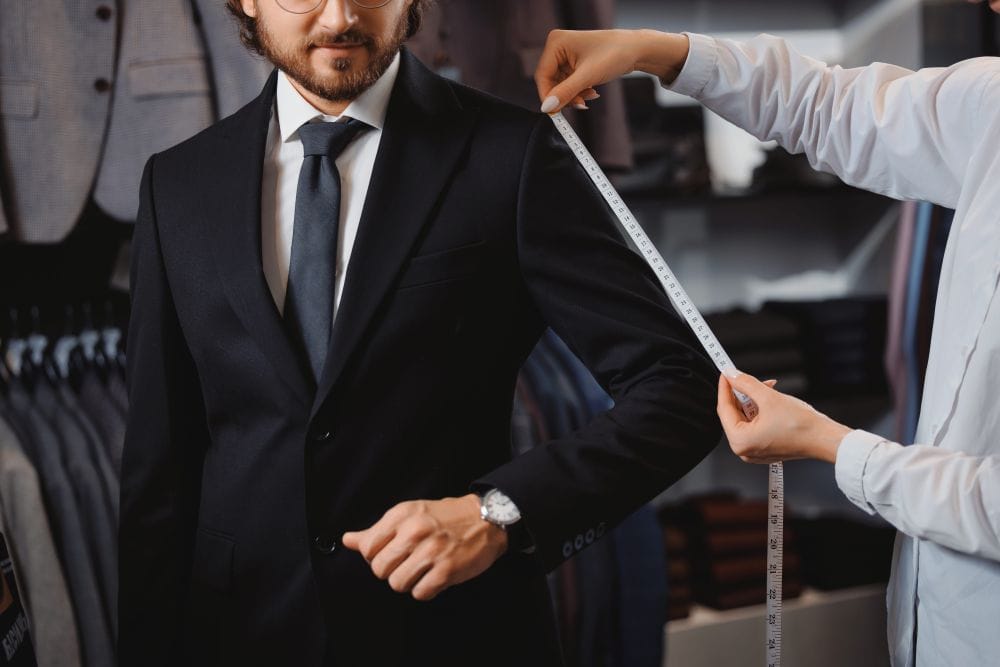
- Shoulder width: goes seam point to seam point across your upper back. Having a second person is helpful here.
- Waist: measure where trousers actually sit, not where you’d like your waist to be.
- Seat: wraps around the fullest part of your hips with the tape flat.
- Sleeve length: runs from the shoulder seam down to the wrist bone with your arm relaxed.
- Jacket length: runs from the base of the neck down the front, ending around the thumb-knuckle line.
For trousers, have the waist snug with one finger of clearance, and inseam from the highest inner point down to your desired hem.
Avoid the common mistakes of pulling the tape too tight, puffing the chest, measuring over a heavy jacket, or trying to do back and shoulders alone. Take each measurement twice and write everything down.
How to Read a Suit Size Chart
A suit size chart looks intimidating until you understand the code. A size like “40R” has two parts: the number is your chest measurement in inches, and the letter tells you the jacket length. S (Short) is for men roughly under 5’8″, R (Regular) for 5’8″ to about 6’1″, L (Long) for taller than that.
To translate your measurements into a size, take your chest measurement in inches as your base jacket number, choose S, R, or L based on your height, and pull your trouser size from the separate waist and inseam. Suit trousers usually run with a fixed six-inch “drop” from the jacket chest, so a 40R jacket typically pairs with a 34-inch waist trouser.
However, a size chart cannot capture your drop, shoulder slope, posture, and body proportions outside standard ranges. If you’re between sizes, go up on the jacket size as there’s more fabric to take in on a larger jacket, but none to add on a smaller one.
When a Size Chart Is Enough and When It Isn’t
For men with standard proportions who need a suit for occasional wear, off-the-rack sizing works well enough, though you’ll still likely need sleeve and hem adjustments.
A tailor becomes worth the money when the chest-to-waist drop is large, which is common in athletic or slim builds, when shoulders and chest measure into different size ranges, or when the suit will be worn frequently and needs to hold its shape.
Before committing to a suit size, pair the measurements with a visual fit check against how your suit should fit. Shoulders, chest, jacket length, and trouser break all have visual tests that you won’t catch with a tape measure.
Tailored Suit Pricing in Bangkok vs. Off-the-Rack
Most first-time visitors are surprised by tailored suit pricing in Bangkok. Entry-level bespoke suits start from around THB 6,000 to 12,000, which is often competitive with mid-range off-the-rack suits in Western markets, without the compromises on fit.
But custom pricing accounts for aspects not included in standard options, such as exact hand measurements, climate-appropriate fabric choices, and multiple fittings to adjust for posture and body shape. For those on a tight schedule in Bangkok, getting a custom suit is feasible even for brief visits, with many tailors providing a 3-5 day completion time, or a 24-hour express service.
Working with Custom Tailors in Bangkok
Self-taken measurements provide a baseline, whereas a tailor can capture precise details like shoulder slope, posture, and common male body asymmetries, while also advising on fabric choices for the suit’s intended wear.
When seeing a tailor for the first time, have your measurements written down, bring a suit that fits acceptably for comparison, and know the suit’s intended purpose. The ideal tailoring of your suit varies depending on whether it’s for daily business wear, occasional formal events, or weddings.
The tailoring process may also vary tailor to tailor. At Perfect Tailor, our process runs consultation, fabric selection, precise measurement, and fittings through to final delivery. During the initial consultation, alignment on how your suit should fit, fabric, and occasion are the first step before a single panel is cut.
Achieve Your Ideal Fit with Perfect Tailor
Measuring for a suit may seem complex, but accurate suit measurements come down to seven or eight body points, being the chest, waist, seat, shoulder width, sleeve length, jacket length, inseam, and neck. A suit size chart turns your chest number into a starting size, but a tailor is able to account for posture, shoulder slope, and the drop between chest and waist that make up a properly fitted suit.
If you’re looking to get your ideal suit, our team at Perfect Tailor on 833 Sukhumvit Road has more than 25 years of experience taking precise measurements and running fittings. We offer fabric options spanning lightweight linens for Bangkok’s climate through premium imported wools, with three to five day standard delivery.
Book a fitting with Perfect Tailor today for a consultation with our team of custom tailors in Bangkok. We can turn your measurements into a suit that reads properly on your body.
References
- Suitsupply. Retrieved 3 July 2026, from https://suitsupply.com/en-us/journal/how-it-should-fit.html
- The Art of Manliness. Retrieved 3 July 2026, from https://www.artofmanliness.com/style/clothing/good-fitted-suit-visual/
Frequently Asked Questions About Suit Measurements
Q: Can I really measure myself for a suit accurately?
A: You can get close, but having a second person makes a real difference for the back, shoulder, and jacket-length measurements. For an off-the-rack purchase, self-measurement is usually enough to pick the right size and adjust with alterations. For a custom suit, however, a tailor’s measurement session is a separate step and worth the visit.
Q: What does the “R” mean in a suit size like 40R?
A: The number is your chest measurement in inches, and the letter indicates jacket length matched to height. S (Short) suits men roughly under 5’8″, R (Regular) suits 5’8″ to around 6’1″, and L (Long) suits taller builds. In practice, this means a 40R fits a 40-inch chest at a regular height.
Q: What if I fall between two sizes on a suit size chart?
A: Size up on the jacket. A slightly larger jacket has fabric to take in during alterations, while a slightly smaller one has nothing to give. Trouser sizing is more flexible since the waist can be let out or taken in more easily than a jacket’s chest.
Q: How often should I re-measure for a suit?
A: Re-measure after any noticeable change in weight, fitness, or posture, or every two years as a baseline. Bodies change, and a suit is likely to miss if it was ordered against measurements from three years ago.