




A Guide to All Types of Suits for Women & Which to Wear
Key Takeaways
- Most women’s suits are defined by what pairs with the jacket: trousers, a skirt, a dress, or a waistcoat for a three-piece.
- Cut, breasting, and length then change how any of those combinations looks, so they overlap rather than form a fixed list.
- A pantsuit and a trouser suit are the same outfit, named differently by region.
- For work, weddings, and formal events, the dress code decides more than the suit name does.
- Body-shape labels are optional shortcuts. Comfort, the proportions you want to emphasize, and your own measurements matter more.
- Once a style is chosen, choosing custom tailored suits for women lets you adapt a piece to your measurements.
The main types of suits for women are pantsuits, skirt suits, dress suits, and three-piece suits. Each serves a different purpose, from business meetings and interviews to weddings and formal events. Understanding how these styles differ makes it easier to choose a suit that suits both the occasion and your proportions.
What Are The Different Types Of Suits For Women?
Among all types of suits for women, the main ones are the pantsuit, the skirt suit, the dress suit, and the three-piece. Each is defined by what the jacket is matched with, so this is the clearest place to start.
| Suit type | Main pieces | Best for |
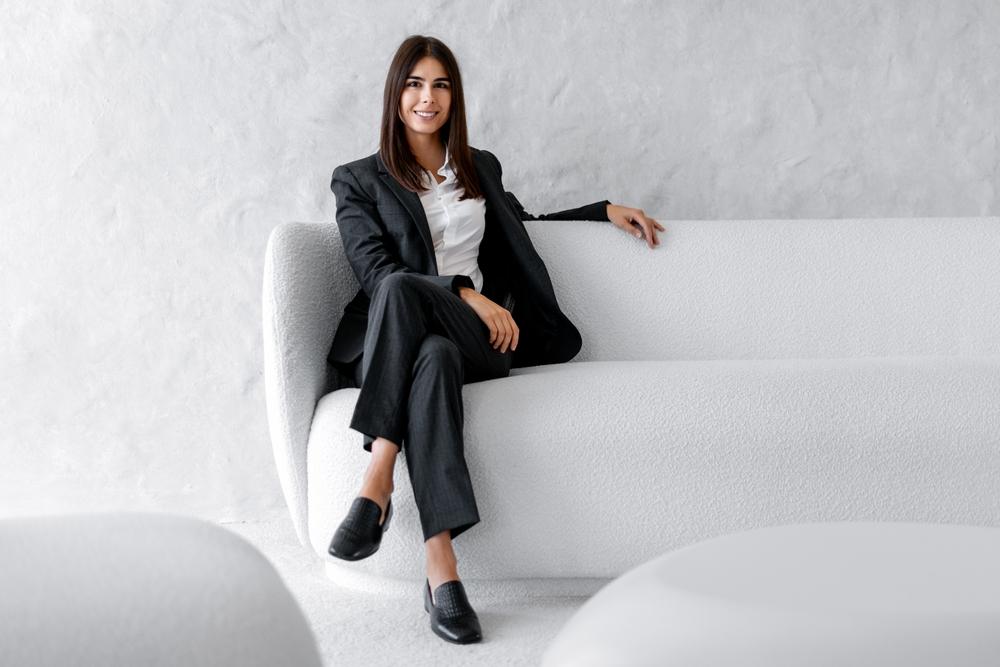
| Pantsuit (trouser suit) | Matching jacket and trousers | Work, conferences, weddings |
| Skirt suit | Matching jacket and skirt | Corporate offices, formal daytime events |
| Dress suit | A dress with a matching jacket | Occasions and ceremonies |
| Three-piece | Jacket, trousers or skirt, waistcoat | Formal business and statement dressing |
“Pantsuit” is the North American term and “trouser suit” the British one for the same outfit. “Dress suit” varies by retailer, so read it here as a structured dress worn with a matching tailored jacket.
The three-piece is really a configuration rather than a separate category, which shows why stacking every descriptor into its own “type” misleads: a slim-fit, double-breasted pantsuit is still one pantsuit. Beyond the primary categories, women’s suits are commonly described by their construction and fit, including single-breasted, double-breasted, slim-fit, oversized, tuxedo, and business styles.
Cut, Fit, and Length Change How a Suit Reads
Consider these features when choosing a suit. Each one sits on top of the combinations above and changes how each one looks.
- Single-breasted or double-breasted. Both are offered for business suits, and the overlapping double-breasted front reads a little more structured.
- Fit. A classic fit gives straight lines with room to move, a slim fit is tailored through the waist and sleeves, and an oversized cut still needs deliberate proportions rather than simply being large.
- Jacket length. A cropped blazer ends at the waist or above the hip, while a longer jacket changes where it meets the waist and hips.
- Details. Satin lapels and statement buttons are common on formal suits and lift a plainer silhouette.
Which Women’s Suit Style Is Best For Work, Weddings, Or Formal Events?
The dress code influences the choice of suit for work, weddings, and formal events more than the style name does. Begin with the occasion, then choose the fabric and combination that suits it.
| Occasion | Styles to consider | What guides the choice |
| Work and interviews | Pantsuit, skirt suit, or three-piece | The workplace’s level of formality |
| Wedding guest | A dressy pantsuit or coordinated skirt suit | The invitation; avoid white, ivory, cream, and champagne |
| Bride or wedding party | A tailored pantsuit or dress suit | The wearer’s role and the overall styling |
| Formal evening | An elegant formal pantsuit or dress | Black tie usually means an evening dress; check the code |
As a general rule of thumb, conventional black tie calls for an evening dress, relaxed black tie allows tailored evening trousers, and white tie calls for a gown.

How Do I Choose The Right Suit Style For My Body Shape?
Start with what you want to emphasize and how you move. Going by shape labels is viable, but treat them as optional shortcuts for getting a starting point.
If You Want More Waist Definition
- Single-button jackets: The single fastening naturally draws the fabric in at the narrowest part of your torso.
- Slim-fit tailoring: Eliminates excess, boxy fabric that can hide your natural shape.
- Belted styles: Physically cinches the waist to create an instant hourglass effect.
If You Want To Balance Broader Shoulders
- Straight-leg trousers: Adds visual volume to your lower half, ensuring you don’t look top-heavy.
- Longer jacket lengths: Draws the eye downward and elongates the torso, softening the horizontal line of your shoulders.
If You Want To Create More Structure
- Defined shoulders: Uses tailoring, seams, or light padding to build a sharp, crisp upper line.
- Double-breasted jackets: The overlapping fabric and symmetrical buttons add architectural rigidity and fullness to the chest and torso.
Most times, what feels comfortable when you sit, walk, and reach is a better guide than any single label.
Custom Women’s Suits at Perfect Tailor
Once a style is clear, a made-to-measure approach adapts it to your build and measurements. Perfect Tailor’s women’s collection spans business, formal, and wedding suits, along with casual and smart-casual blazers, with pantsuits, skirt suits, and dress suits all available.
The cut is adjusted to suit your shape, with fabrics that range from fine wool to breathable linen for Bangkok’s climate. Our skilled tailors and consultants run a style and fit consultation before any tailoring begins, so the combination, cut, and fabric are settled together.
Most women’s suits take three to five days, with a 24-hour express option for urgent orders, but it’s worth confirming availability for a specific piece.
Choose Your Ideal Types of Suits for Women with Perfect Tailor
The types of suits for women are defined first by what pairs with the jacket, then shaped by breasting, fit, and length. Work, weddings, and formal evenings each come down to the dress code, and your proportions and how you move should guide the cut.
Perfect Tailor’s women’s collection includes business, formal, wedding, and smart-casual styles, featuring classic and slim fits, supported by advice from multilingual consultants.
Browse custom tailored suits for women at Perfect Tailor. Compare styles by occasion, with classic or slim fit and a 24-hour express option for urgent orders.
References:
pantsuit. Retrieved October 28, 2026, from https://www.oxfordlearnersdictionaries.com/definition/english/pantsuit
Deconstructing Dress Codes. Retrieved October 28, 2026, from https://debretts.com/deconstructing-dress-codes/
Formal Wedding Attire: A Guest Dress Code Guide. Retrieved October 28, 2026, from https://www.theknot.com/content/formal-wedding-attire
Frequently Asked Questions About Women’s Suits
Q: What is a women’s suit called?
A: “Women’s suit” is the general term. A matching jacket and trousers is a pantsuit or trouser suit, while a matching jacket and skirt is a skirt suit.
Q: Are a pantsuit and a trouser suit different?
A: No. They describe the same outfit of a matching jacket and trousers. “Pantsuit” is used in North American English and “trouser suit” in British English.
Q: Is a blazer with different-colored trousers a suit?
A: Not quite. That is an outfit made from separates rather than a matching suit. Separates can still look polished and suit less formal dress codes.
Q: Can one suit work for both daytime and evening?
A: Often, yes. A versatile pantsuit can move from office to evening through changes in the top, shoes, and accessories, though that does not make it black-tie formal.